19th edition
Hackfest 2027
Nineteen lines on the board, nineteenth edition. One stone left to complete the glider.
October 2027 · Quebec City, QC
- Trainings
- Oct. 18 to 21
- POLAR
- Oct. 21
- Hackfest
- Oct. 21 (6 PM) to 23
The dates
- Trainings October 18 to 21, 2027
- POLAR October 21, 2027
- Hackfest, 19th edition October 21 from 6 PM, October 22 and 23, 2027
The theme: Go
Go is played on a 19 by 19 board, and 2027 is the 19th Hackfest. Our mark brings four ideas together.
-
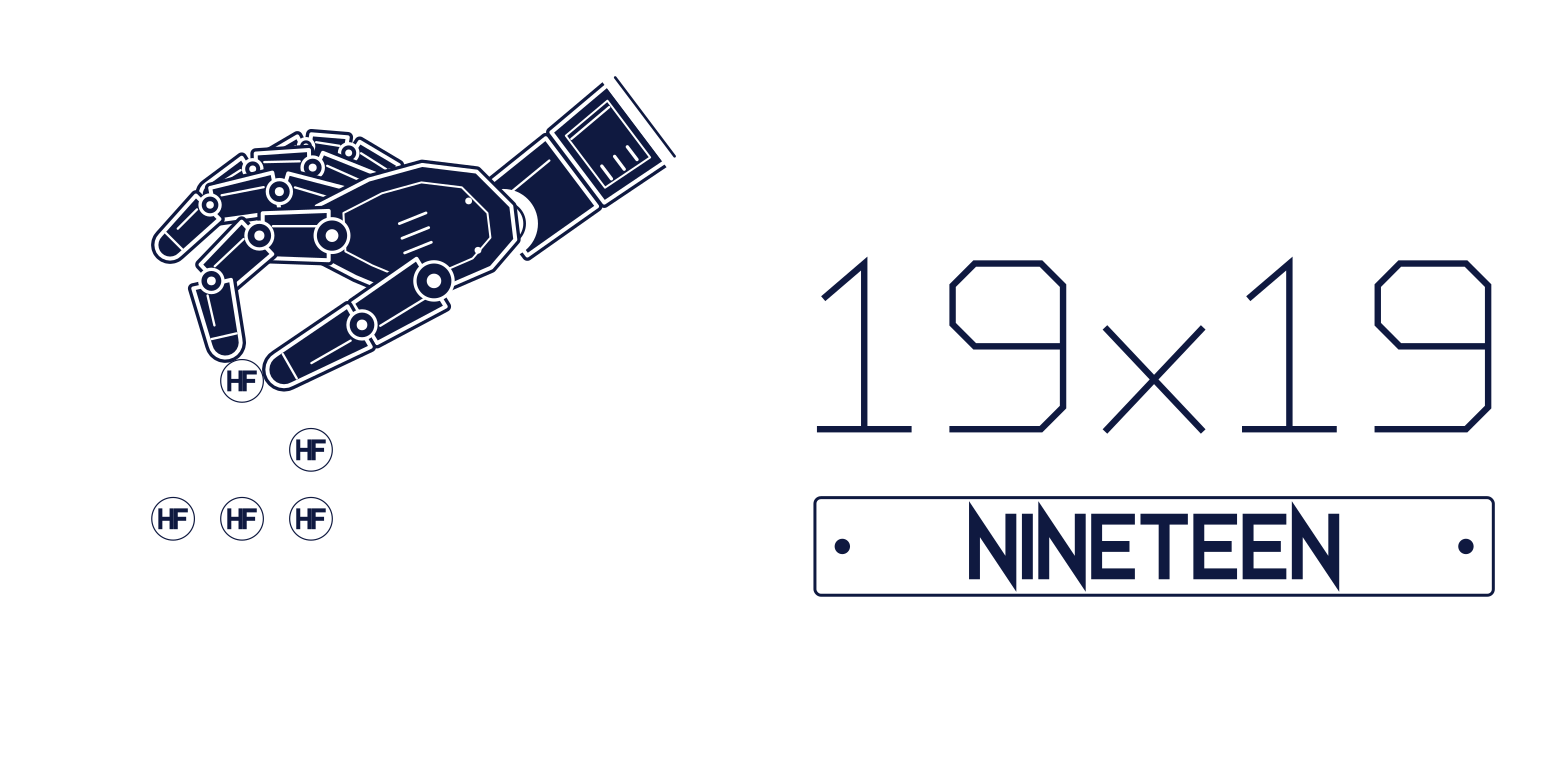
The 19×19 board
A standard Go board has 19 lines by 19, and this is the 19th Hackfest. The logo shows the top-left corner of the board. In Go, lines are numbered from 1 (bottom) to 19 (top), so this corner runs from line 15 to line 19, and the last stone lands on line 19, at the edge of the board. On a real board, this corner also carries a hoshi (star point) at D16, on the 4th line from each edge.
-
The glider
The five HF stones sit on line intersections, as in real Go, and form the glider from Conway's Game of Life, the long-standing hacker emblem. Four stones are already on the board.
-
The last stone
A robot hand holds the stone like a Go player, between index and middle finger, and places it on line 19 to complete the glider. It is the moment a hack comes together: the strategy of Go, the emergence of Life and the precision of the machine. That hand is AI: it now plays alongside us, on defence and on offence, and it is the one placing the decisive stone. The question is who guides it.
-
A 19 in the colour
Even the theme's navy plays along. Its hex code, #0F1940, reads as three pairs: 0F, 19 and 40, with the 19 right in the middle. And 0F is 15 in decimal (the colour is RGB 15, 25, 64), the first line of the corner drawn in the logo. So the colour code also runs from 15 to 19.
The glider, the hacker emblem
Five stones, a few simple rules, and the pattern starts moving on its own. It is the glider from the Game of Life, adopted as an emblem by the hacker community in 2003. It sums up what we do at Hackfest: understand the rules of a system, then find the behaviour nobody planned for. Like an exploit chain, or an AI that surprises the people who built it.
Your move: click an intersection to place or remove a stone, then start the game.
- Longevity
- 0
- Stones born
- 0
- Max in one turn
- 0
- Record
- 0
Claim your spot on the board
Tickets for the 19th edition are on sale. Take position early.
The game starts soon
The call for papers for the 19th edition will be announced on this page and in the newsletter.
Put your organization on the board
2027 partners take position early. Let's talk about your presence at the 19th edition.